Posted on 20 Jan 2026.  Share
Share

Note: This article is meant for intellectuals only
Part-1 Part-2
[Shri. Ajay asked: “Bhagavan Shri Satya Sai Baba was repeatedly telling that every human being is God, which perfectly coincides with the Advaita Philosophy of Shankara. This philosophy is opposed mainly by the concept that a specific human being alone is God, which is contemporary human incarnation. Reconciliation of these two contradicting concepts is to be clarified and this is the basic necessity in the spiritual knowledge”.]
Shri Swami Replied: First, let us take the most important and most sacred epics like the Shrimad Ramayanam and the Shrimad Bhagavatam, which represent the concept of the specific contemporary human incarnation. Thus, we are starting from one side thoroughly after which only we can speak about the other side. The spiritual aspirants in both these sacred epics are Hanuman and Gopikas and let us check their background. There can be no better scholar than Hanuman, Who studied the philosophy directly from Sun. If we studied one grammar (Vyakarana Shastra), He studied nine grammars in Sanskrit. Moreover, He got spiritual knowledge directly from Sun, the first student of God, (Imaṃ vivasvate – Gita) in whom the dark ignorance can never find a place. Similarly, Gopikas were sacred sages doing penance of knowledge (Jnana Yajna) for millions of births and there can be never a better scholar than these sages. Actually, people misunderstand that the sages were always doing sacrifices involving burning ghee in fire altars. This is a totally misinterpreted and misunderstood concept. The highest sacrifice is the debate on spiritual knowledge by which alone God is pleased and such sacrifice of knowledge is far higher than the foolish sacrifice involving materials like ghee (Jñāna yajñena…, Śreyān dravyamayāt… Gita). The sages born as Gopikas, after passing through such millions and millions of spiritual debates in the past, are now in their final birth to get the everlasting grace of God. This means, the sages have come to the final conclusion of all their debates in this birth.
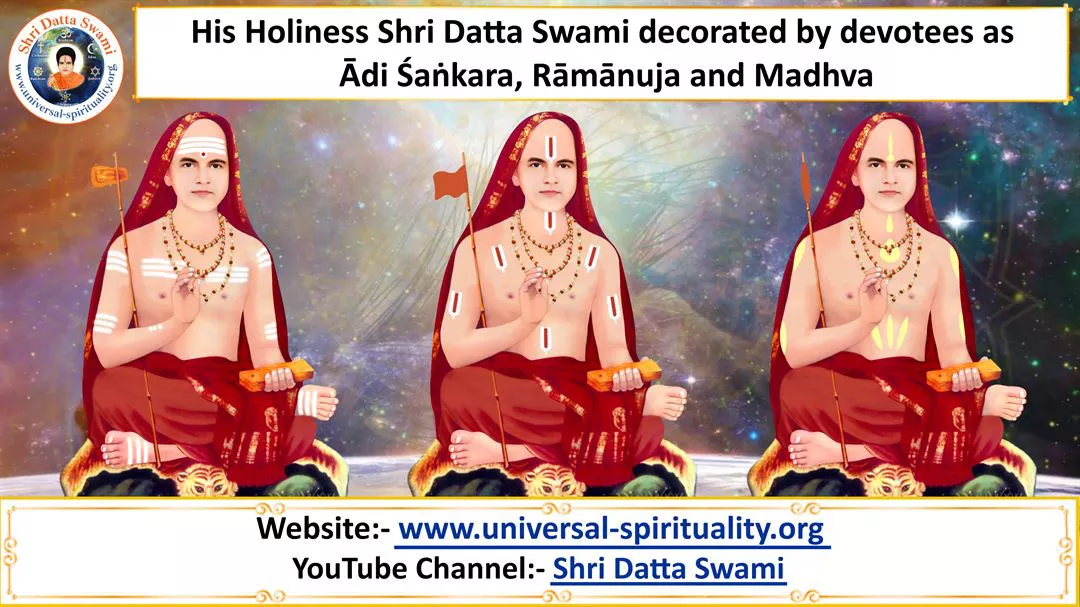
All this is the effort to say that there can be no better spiritual aspirant than Hanuman and Gopikas. The knowledge should be always perfectly reflected in the practice and then only the real fruit is attained. The final conclusion of your long discussed knowledge alone is transformed into your final practice. Arriving at the right conclusion (Jnana Yoga), developing the force of concentration to transform the right conclusion into practice (Bhakti Yoga) and the final practice (Karma Yoga) are the three subsequent stages of spiritual path preached by Shankara, Ramanuja and Madhva in sequential manner. This sequential manner is seen even in the issues of worldly ways. Therefore, there is no doubt to say that the final right conclusion decided by your intelligence through analysis conducted internally and externally also with the help of scholars is known by this world only through your finally implemented practice. Let us see what these highest spiritual aspirants (Hanuman and Gopikas) practiced in their lives by which we can easily know their final conclusions arrived at through their long study and debates. Their final conclusion practiced is: Only the worship of a single contemporary human incarnation called Rama and Krishna respectively and they neither worshipped the statues of upper energetic incarnations (like Vishnu, Shiva etc.,) or past human incarnations (like Vamana, Parashurama etc.,) nor memorized constantly that they are God declaring that the soul is God. We have proved this concept with the help of the perfect witness, which is the traditional procedure in the honorable court of law. Here, since the witness represents highest perfection, there is no place for wrong witness, which means that whatever witness you show for the contradicting concept must be imperfect and wrong. Moreover, the witness on your side, sometimes, happens to be witness of our side also and we agree that your witness is also perfect since we don’t contradict at all this point. Of course, the perfect witness like Shankara and Bhagavan Satya Sai Baba for your opposite concept (our side) also should be examined carefully so that the contradiction between both sides, especially leading to a lot of confusion due to the double standard of your witness can be resolved.
Gradual Fall from Monism Avoids Shock
Careful analysis of Shankara and Shri Satya Sai Baba reveal that often, they are also witness to our side, whereas our side witness always remains with our side only without any trace of deviation. This means that neither Hanuman nor Gopikas ever spoke about monism with God and they always spoke about dualism only. On the other hand, even though the opposite witness (your side) spoke about monism often, at least now and then, dualism was also spoken by them. Let us take Shankara: He often mentioned the monism between the soul and God in His commentaries. But, in one prayer to Lord Jagannadha, He says “even if we achieve removal of the difference between God and soul, this difference appears since soul is a wave and God is ocean. Neither soul can become God like a wave that cannot become ocean, nor can God become the soul like the ocean that can never become a wave”. Shankara has already given the concept of Ramanuja, which is that soul is a tiny part of God (Shesha-Sheshi). But, He mentioned both the contradicting concepts like removal of difference and existence of difference between God and soul. The verse composed by Shankara addressing Lord Jagannatha (Satyapi bhedāpagame…) shows two opposite concepts. The meaning of the verse is that even though the difference between God and soul disappears, neither soul is God nor God is soul just like neither the wave is ocean nor the ocean is wave. Both these opposing concepts cannot contradict each other if you apply both to different cases. The first case of disappearance of difference is human incarnation and the second case of difference between soul and God is an ordinary soul. If you apply both these concepts to one case only, the contradiction appears resulting in confusion.
The last Madhva said that God and soul are totally different except that both are made of same awareness. This is a gradual fall of 100% monism of Shankara to 10% monism of Ramanuja and finally falling to 1% monism of Madhva. This gradual fall follows the principle of avoiding sudden fall of the ambition of human psychology from 100% monism with God to 10% and then to 1%. Once a soul is fixed in 100% monism to fulfill its highest ambition of an atheist in the time of Shankara, there should not be a sudden fall from this stage to 0% of Datta Swami and hence a gradual fall of monism is shown to avoid sudden shock to human psychology of atheist converted into theist by the assurance given by Shankara. After coming to the final 1% monism of Madhva starting from Shankara (100% monism) through the intermediate stage of Ramanuja (10% monism), the ambition of the soul is gradually reduced from 100% to 1%. This is the proper state where we can bring down this trace of 1% monism to 0%. It is easy to achieve 0% from 1% than achieving it from 100% or 10%. Hence, after Madhva, this Datta Swami appeared like the final dissolution of the world (Maha Pralaya of ignorance) by which the 0% monism will never rise the ambition again like a burnt seed not giving rise to sprout. One can attain perfect peace either in 100% or in 0% like saying to stand on this bank or that bank of the river and not in the river! Datta Swami achieved this 0% monism since God is unimaginable (beyond space) and any soul is imaginable awareness. After showing perfect witness on our side, we are showing the opposite witness supporting our side also, at least some times so that the self-contradiction of the opposite witness can be resolved through analysis and there is no need of analysis of witness on our side due to absence of any self-contradiction in our witness. There is no need of cross examination of our witness, which is to be done to the witness of your side only due to the self-contradictory statements of your witness, of course, resolved through careful analysis.
Shankara established in the commentaries that soul is God. It means every human being is God. All His disciples followed this theory and were feeling that each one is God (Śivo'ham or So'ham). One day, Shankara drank wine. Every disciple also drank wine thinking that there is no sin in it. They thought if Shankara-God can drink wine, why not the disciple-Gods also drink the same? Hence, every disciple drank wine. Next day, Shankara drank molten lead and the other disciple-Gods could not do the same and fell on His feet! This brought out the clear difference between God and soul. All the soul-Gods could not drink molten lead except Shankara-soul-God. The conclusion is that no soul is God except one Shankara-soul, which alone can be considered as the contemporary human incarnation. All the disciple-souls fell on the feet of Shankara-incarnation. Then Shankara told that He alone is God (Śivaḥ kevalo'ham). The word 'kevala' means alone. Similarly, Shri Satya Sai Baba also said both versions like Shankara. Shri Satya Sai Baba told often that every soul is God. At the same time, Shri Baba told some times in His speeches that if a human being behaves practically bad and says that still he is God, it is just madness of that human being.
By this statement, the cat, the original idea of Shri Baba came out, which is nothing but the reformation of human beings using the twisted concept of monism. Bringing out good pragmatic results is always appreciated even though truth is distorted for that purpose. Such twist for good result is called as Arthavaada (Artha= for the sake of good result, vada=telling twisted truth). The mother says to the child that if it eats food, moon will come down. Such lie is allowed to make the child eat the food well and grow. No scientist files a case against her in the court that she is propagating unscientific lies in this way! Not only this, can any human being do miracles as Shri Baba did? If you say that the human being-Gods are covered by ignorance so that they do not know that they are Gods to do miracles, can ignorance cover God? Even if it covers, it can vanish by simply hearing that one is God. Is God covered by such strong ignorance, which does not vanish even after reminding Him the truth? Then, what is the difference between God and a most ignorant person? Actually, Shankara was questioned on this point by the atheists converted as theists. Shankara told that the ignorance is very strong and can vanish only by constantly thinking that one is God. People did the same as per the statement of Shankara. Still, they could not become God to drink molten lead! Then, finally, Shankara replied that one can become God only by the grace of God (Īśvarānugrahādeva...). This clearly means that the human being is not God and God exists separately from whom the grace is to be obtained.
Present Society in Worst Condition in Pravrutti
Shankara faced forcible inevitability in introducing 100% monism since He was surrounded by atheists only, who said that a separate God never exists. Except this, they will not listen anything else. There is no other way than to follow monism to make atheists believe in the existence of God. Shankara agreed to the concept of atheist by saying that there is no separate God since the atheist himself is God. Atheist has to accept the existence of God since he himself, called as God by Shankara, exists. In this way, using 100% monism, atheist was turned to theist to say at least that God exists. That much was the highest achievement of Shankara at that time since the case was a strong atheist. It is like the parents feeling highest happiness when their dumb son uttered the first letter ‘A’! At that time, all were Buddhists and Purvamimaamsakas, who were totally atheists. The former was doing all sins since world was nothing (Shunyam) for them. The latter were killing innocent goats in the sacrifices to attain heavenly pleasures. When they believed that each one of them is God, by the efforts of Shankara, doing such sin (killing goats) was arrested since the sacred God never does any sin since nothing is to be attained by God. The sacrifices were done for getting small heavenly pleasures. Since God is always infinite-blissful ocean, there is no need of any sacrifice to get small heavenly pleasures and hence sacrifices in which goats were killed had to be stopped. If they do not stop, they will lose the status of God attained by them from the offer of Shankara without any effort like a lottery! Like this, for the reformation of the society in Pravrutti, the Nivrutti-philosophy is used with a twist that every soul is already God and one has to simply know this truth! So also, Shri Baba used this twisted monism for the reformation of society in Pravrutti. The present society is in worst condition as far as Pravrutti is concerned. Like Shankara, Shri Baba also used the flash of twisted monism for the reformation of souls in Pravrutti. God does not mind to sacrifice even His status if some good benefit can happen to this society like reformation of souls. A demon can never do such sacrifice of free status of God for the sake of the society. If the employees promise to function well in an office on changing their designations, Director, the Head of the office, does not mind to sacrifice his status to every employee of his office. He will give new designations for all the posts like Director-accountant, Director-typist, Director-peon etc. His only desire is that his office should run with perfection and peace.
The human beings in the society are doing bad deeds (sins) due to bad aims or bad thoughts. First, all the bad thoughts should be thrown out from the soul like bad employees from the office. Now the individual soul is like a vacant office. The group of thoughts is the individual soul. When the bad thoughts alone exist, they should be thrown out and by this, the individual soul is not thrown out. It is not like throwing out the golden jewels (bad thoughts) but removing jewels by melting so that the pure gold (pure awareness) remains. After this, the pure awareness, called as pure individual soul, remains, which is almost looking like the soul (inert energy without thoughts). Soul is the pure inert energy and pure individual soul is pure awareness. Soul is the causal side and pure individual soul is the product side of same entity. Pure awareness is a specific work form of pure inert energy. The pure awareness of individual soul without thoughts and aims to do works exactly looks like the pure inert energy of the soul. The only difference between soul of pure inert energy and individual soul of pure awareness is that the soul is inert whereas the individual soul is non-inert. Due to this 99% similarity, the pure individual soul is called as the soul itself. Hence, the soul of Shankara is not inert but pure awareness since the soul is viewed almost as the pure individual soul.
The soul is qualitatively similar to inert cosmic energy that forms various items of the world. But, the soul is quantitatively different from cosmic energy since soul is drop whereas cosmic energy is huge ocean. Due to the qualitative similarity, the soul is said to be the cosmic energy that generates, maintains and dissolves this world. The quantitative difference between soul and cosmic energy is neglected. One can take a small piece of gold and say that the piece of gold is source of all jewels overlooking the quantitative difference. The similarity between soul and pure individual soul is lack of doer-ship (kartaa) and enjoyer-ship (bhoktaa) in both even though reasons are different. The reason for the soul is inertness and for the pure individual soul is thoughtlessness. The end result is same in both. Due to this similarity of end result, pure individual soul is treated as soul that creates world and thus through this chain of similarities, the individual soul (called as soul) is considered as the creator of world. All these logical chains were used by Shankara to make the pure individual soul of a human being to be God, the creator of world. All these chains of logic twist the monism, which alone is true in energetic or human incarnation. This twist was not only essential to convert atheist into theist, but also essential to purify the soul from sins since God is thoughtless awareness as defined by Shankara. Both pragmatic results were achieved: 1) The atheist speaks that God exists and 2) The soul is purified eliminating all bad thoughts (all thoughts since there was no single good thought). Up to this stage, the philosophy of Shankara works out.
A human being in this stage will not do sins, but also will not do good deeds and remains as the pure awareness without thoughts, which is the pure individual soul leftover with pure awareness looking like its basic inactive inert energy (soul). In this stage, the individual soul is almost looking like soul and is called as the soul itself. Thus, the soul of Shankara is pure awareness without thoughts, which is almost like a soul or inert energy. The actual soul is only the basic inert energy, which is naturally without any thought that forms the entire cosmos from which only all this world is generated. The soul of Shankara is also without any thought even though it is pure awareness. By this, you should not mistake that the soul spoken by Shankara is not the actual inert soul (inert energy), but, the individual soul becoming thoughtless remaining as pure awareness looks like exactly the actual inert energetic soul without any thought. Reformation of human beings should not stop here by simply eliminating negative signs (sins) and resulting in sign-less zero. The aim is not only avoiding sins, but also, doing good deeds. From this stage of zero, Ramanuja and Madhva developed positive sign or doing good deeds. The Goal of Shankara was pure awareness without thoughts (Nirguna Brahman), which is zero, resulting after elimination of all bad thoughts including a few good thoughts also, if at all exist. An antibiotic used, not only kills the huge bacteria, but also a few living cells leading the patient to a very weak zero state. Now, you have to use tonics to improve the health from this weak state to positive sign. Inevitable killing of few living cells shall be ignored while bringing the individual soul mostly filled by bad thoughts (to do bad deeds) to a zero state of thoughtlessness is the final aim of Shankara in the long journey of reformation of the soul.
The next stage after Shankara is of Ramanuja and Madhva, who told that the goal is God with all good qualities (saguna Brahman) without any bad quality indicating the future process of filling the pure awareness of soul given by Shankara with good qualities neglecting the entry of very few bad thoughts into the soul, which generally aspires always to become God, the highest goal. This is like the subsequent stage of appointing good employees in the vacant office after removing bad employees in whom one or two good employees might have also existed. God qualified with good qualities (kalyana gunas) cannot only be unimaginable, but also not even be formless and should be qualified by a specific form, which was called as Narayana (Saguna Brahman) by both Ramanuja and Madhva. The qualified soul (jiiva) is confined to a specific form, which cannot become other specific form of God, called as qualified God or Narayana, in which case, monism with Narayana is not possible and hence dualism was brought into picture. Here, you should not find fault with these theoretical exercises of divine preachers since good practical result to reform the souls existing in a specific stage in their times was their ultimate goal. Without understanding this practical background, followers of these divine preachers quarrel with each other. If the truth is not twisted at all, there will be perfect unity in the philosophies of these divine preachers. When the twists are present, which differ according to the then requirements in the process of reformation of souls, naturally, the differences arise and these are not the original concepts of them regarding different truths. Truth is always one and all the three preachers know very well that truth.
The unimaginable God is adjusted by Ramanuja and Madhva in the unimaginable power of Narayana, who is the substratum of the unimaginable God and for this, the verse in the Gita was taken as authority (Brahmaṇo'pi Pratiṣṭhāham…). This is again a twist in the concept of the highest goal, the unimaginable God. The aspirant does not mind whether the goal is unimaginable God or the power of goal (Narayana) is unimaginable since attaining unimaginable status of God or power is the ultimate ambition of any soul. In the case of Shankara, the formless pure awareness can exist equally in all human beings. But, the qualified God with a specific form cannot exist in all the souls like the common pure awareness and hence, later on, dualism has to result. In such case, the tiny qualified soul (with at least some good qualities) with a small human body called as “Sukshma chidachit vishishta” can become a part of the huge world body. In this huge world body made of five inert elements called as Vishva, mingled with forms of collective inert energy called as Virat, very huge collective soul (all the souls viewed like a very large group) called as Hiranyagarbha, the first huge soul, also exists. This huge world-body containing non-inert Hiranyagarbha, inert Virat and inert Vishva appears as the external gross body (Sthula Shariram) of the qualified God existing as energetic incarnation with unimaginable powers (Narayana). This unimaginable power of Narayana makes the energetic body as unnatural and unimaginable (Apraakruta Shariiram).
The ultimate God is the mixture of ‘awareness with unimaginable power’ as soul and the unimaginable body. The existence of unimaginable power in and out makes Narayana as the ultimate God without isolating the soul from body. The body is given equal importance to be treated as God so that a part of the body can be a part of the God so that whole-part relationship is maintained between God and soul and not the total monism. Thus, for every step of the philosophy, there is an ultimate goal of practical reformation of the soul for the benefit of the society. Without understanding this, followers blindly fight with each other. In qualitative angle: 1) both large (Hiranyagarbha) and small (individual soul) souls and 2) both big (Virat-Visva) and small (human body) inert parts exist. Both 1) and 2) are taken as common non-inert and inert parts of bodies of God Narayana (world) and an ordinary human being like Svetaketu (human body) showing qualitative similarity to maintain Advaita (monism) on one hand. On the other hand, the difference between God Narayana and ordinary human being through the unimaginable aspect of power possessed by Narayana shows dvaita (dualism). The actual concept of Ramunaja is only dualism and above mentioned monism is only to console sudden fall of ambition. God Narayana is completely isolated from the ordinary human being, which is only a part of God’s huge external gross body. Nothing is leftover in the human being to be compared with God Narayana. The pure individual soul present in the human being with good qualities may be compared to Narayana without any direct relationship. If you leave the concept of comparison and come to the reality of the relationship, it only says that the entire human being composed of inert—non-inert body and the individual soul in the top head portion totally goes into the external huge gross world body of God only. Superimposing God on the world body (like superimposing the soul on the human body), a twist is given that the human being is a part of world body called as God and hence finally can be called as part of God. Later on, Madhva made more clarification recognizing the consolation given to ambitious soul.
He separated the world-body from Lord Narayana as totally external item like a pot separated from the pot-maker, which cannot be called as the gross body of the pot maker. Now, the pot-maker cannot be superimposed on the pot so that a small part of pot cannot be called as the part of the pot-maker. By this, the consolation that a part of the pot (soul) is a part of the pot-maker (God) vanishes and perfect dualism between part of the pot and pot-maker results. However, Madhva consoled the human being by showing that the soul in Narayana and the soul in the ordinary human being are made of same awareness. Even this last hope is removed by Shri Datta Swami, who separated the unimaginable God represented by unimaginable power of energetic incarnation (Narayana) and gave the independent and ultimate status to the unimaginable God. The energetic incarnation Narayana becomes unimaginable not due to His inherent power but due to the entry of unimaginable God into energetic form. Similarly, any human incarnation exhibits unimaginable powers not as its inherent powers, but due to the entry of unimaginable God only into it. The actual God being unimaginable and the soul is imaginable (anyway, body is already concluded as imaginable), there is no question of even an iota of similarity between God and soul. All the energetic incarnations (Brahma, Vishnu and Shiva etc.,) and human incarnations (Rama, Krishna, Sai Baba etc.,) are expressions of unimaginable God only pervading all of them homogeneously in and out. For human beings, the relevant human incarnation alone is ultimate God.
Shankara told the atheist with highest ambition that a lottery of one crore is allotted to him, his bank account was also opened into which the entire lot of lottery is deposited and the only step leftover is to go to bank and withdraw one crore immediately! The atheist went to bank to withdraw the amount. Ramanuja was standing outside the bank telling the atheist that 90 lakhs of the deposited amount were taken back as income tax. The atheist was shocked and sat before the bank for some time to subside his B.P. and went inside the bank, Madhva sitting in the chair of Bank Manager told the atheist that 9,99,000/- were withdrawn from the deposit as service tax and Rs.1,000/- only remain, which cannot be withdrawn as the minimum to be maintained. The atheist collapsed, became normal after undergoing treatment in a hospital for some time and came to bank to withdraw the balance Rs.1,000/- to be paid to the hospital. The Bank Manager told that Rs.1,000/- cannot be withdrawn since education cess is leftover unpaid. The atheist became very much discouraged in a state of weeping. Now, Shri Datta Swami approached and advised him that he can earn even Rs. 1 crore by hard work and effort from which the hospital bill can be easily paid off.
100% monism without the concept of the human incarnation of a specific soul presented by Shankara is the best tactful philosophy covering all the souls fully satisfying their highest ambition to become God without any trace of effort and without any problem of jealousy. This is the reason, why the philosophy of monism of Shankara spread very easily throughout the humanity. But, we have to remember that this policy appeared in the atmosphere of 100% atheists and any way even slightly different from this becomes utter failure in such atmosphere. You must understand every philosophy with respect to the prevailing the then atmosphere in the context of what best can be done to change the atmosphere even by the distortion of truth to any extent. Slowly, the atmosphere progressed well and the atheist-turned-theists developed to the higher stage of becoming devotees to achieve 100% monism practically by the grace of God as per the gradual suggestion of Shankara Himself. Ramanuja and Madhva slowly reduced the monism to dualism so that the ambition for 100% monism is brought down to the minimum most 1%. Till now, the path of effort for the transformation of souls is very smooth because the concept of human incarnation that blasts up the jealousy was not stressed at all by any previous preacher except an insignificant mention of it. Touching the ambition is tolerable but hurting jealousy is like throwing a stone on the mud pond as said in the Gita (Tānakṛtsnavido mandān…).
To be continued...
★ ★ ★ ★ ★
Also Read
Unimaginable God And Imaginable Soul
Posted on: 29/10/2024Unimaginable God - Imaginable Soul (part-2)
Posted on: 23/01/2026Fundamental Difference Between God And Soul: Unimaginable And Imaginable
Posted on: 11/12/2015Imaginable Awareness Is Different From Unimaginable God
Posted on: 19/01/2011Imaginable Quality Can Never Enter Unimaginable God
Posted on: 07/10/2015
Related Articles
Shri Dattaguru Bhagavat Gita: Kaalabhairava Khanda: Chapter-16 Part-2
Posted on: 31/01/2019What Is The Reason For The Twist Given By Shankara In His Philosophy?
Posted on: 15/06/2007Datta Veda - Chapter-9 Part-1: Four Preachers Of Vedanta
Posted on: 10/01/2017Spiritual Knowledge With Reference To Non-spiritual And Atheistic Souls
Posted on: 06/09/2022Awareness Separated From Existence Otherwise Every Item Of Creation Has Awareness
Posted on: 06/11/2016