Posted on 16 Feb 2026.  Share
Share

Note: This article is meant for intellectuals only
Part-1 Part-2 Part-3 Part-4 Part-5
Dr. Nikhil asked (on phone):- Advaitins say that the subtle body is made of thoughts (vāsanās) and the causal body is made of ignorance (avidyā). Can You please clarify this point?
FIRST PART
The Four States Analysis Applies Only to an Incarnation
Swami replied: O Learned and Devoted Servants of God! In the case of a human being, the gross body is made of the five elements or matter, the subtle body is made of inert energy and the causal body is made of awareness in the form of thoughts or qualities (Vaasanas). These thoughts (forms of awareness) are the cause of the entire behavior of the individual soul and hence, this body can be called as the causal body. Thus, a human being has three bodies made out of matter, energy and awareness (thoughts) respectively. This also matches with the three states of consciousness namely, the wakeful, dream and deep sleep states, in which the person’s soul is said to be viśva, taijasa, and prājña respectively. But, in deep sleep total ignorance called as Avidyaa exists, which can be the body. But, awareness (soul as pure awareness and individual soul as bundle of thoughts) or the enjoyer is absent in deep sleep due to the resting nervous system. The inert energy exists in the body in deep sleep, which is the basic material of awareness because awareness is a special work form of inert energy in the functioning nervous system. But, even if the inert energy (essential material of awareness) is taken as the soul or individual soul, it can’t be the enjoyer due to its non-awareness or inertness. Thus, the ignorance as body is acceptable whereas the awareness as enjoyer is not acceptable in the case of ordinary human being. If deep sleep is replaced by meditation, this concept finds a place. In meditation, pure awareness (soul) is leftover as the enjoyer whereas the suppressed inactive thoughts (existing as inert pulses or sphotas in the brain) can act as ignorance (Avidyaa) or the covering body of pure awareness so that both enjoyer (soul) as well as body (Avidyaa) co-exist.
The meditation and deep sleep are very close to each other in the sense that total ignorance exists in deep sleep and almost total ignorance (except self-awareness all thoughts are absent as ignorance) exists in meditation. The pure awareness in meditation is almost inert energy in the deep sleep leftover as essential material of soul. In deep sleep, we can’t take the inert energy (soul) as the enjoyer, but, as soon as wakeful state starts, the inert soul becomes pure awareness and enjoys the bliss resulting from the full rest of previous deep sleep and almost the present full rest (since thoughts have not yet invaded the brain) of nervous system. In the brief moments after the deep sleep, thoughts also do not appear and we can say that the pure awareness (soul) covered by ignorance (absence of thoughts) as causal body enjoys the bliss in the state of Praajna. The almost ignorance (absence of thoughts except self-awareness) here can be taken as another cause of enjoyment of bliss apart from the rest of nervous system.
In this way, the immediate moment after deep sleep exactly resembles the meditation state. In both states, pure awareness or soul is enjoyer and almost ignorance is the body of the soul. In the Veda, the Praajna is taken in deep sleep and not in meditation state, who is stated to be the source of this creation indicating that the deep sleep of human incarnation of God is mentioned there. In the case of human form of God, in deep sleep, the unimaginable awareness (unimaginable God) exists as the enjoyer, who is covered by the total ignorance of deep sleep as the body. Here, the ignorance does not exist for omniscient God, the enjoyer. But, in the case of ordinary human being, the ignorance exists for the non-existing awareness or enjoyer. Hence, we can’t say that Avidyaa (ignorance) is the body of God, who is omniscient. God is full of awareness and hence, awareness shall be the body of God and not the ignorance. In the deep sleep of human incarnation, the Veda mentioned awareness as the body and not the ignorance. If you take ignorance as the body, such state is not the deep sleep of human incarnation of God. Only in the case of ordinary human being, ignorance can be the body of the enjoyer and the enjoyer himself is absent and therefore, Praajna can’t exist here. In the case of ordinary human being, in deep sleep, the awareness (soul) disappears, but, the enjoyer can be the mediated God with His unimaginable awareness because the body of human being in deep sleep is a tiny part of this entire world depending on the central mediated God (even though the mediated God is not in the tiny body).
The mediated God having the world as body (vishvaroopa) is enjoying this entire world and hence, happens to be the enojoyer of any human being in all the three states. The mediated God or the first energetic incarnation is having this entire world as His body and hence, the deep sleeping body of human being can be said to have God as its enjoyer in the absence of the soul-enjoyer. In such case, God is not in the body of the human being, but, stands as the supporter of this entire world in which the tiny body in deep sleep is also present. In such case, the central God as Praajna exist as enjoyer and the ignorance in the tiny body exists as Avidyaa simultaneously without any connection between both. This means ultimately that you should not say that ignorance is the body of the enjoyer (God) since both enjoyer and Avidyaa are existing without connection. If you take awareness as the body of the enjoyer, it suits well because the enjoyer-God is with full awareness due to His omniscience. Hence, the Veda mentions awareness as the body in deep sleep and this awareness belongs to the omniscience (Omniscience is treated as close inner body like the shirt and the external world is treated as outer body like coat on the shirt. Both shirt and coat are treated as bodies. The energetic body of God is inner most closest body.) of the God and not to the ignorance of the tiny body.
The Veda also mentions inert energy as the body in dream state and materialized body in awaken state in the case of ordinary human being. Here, we have taken the subtle body as bundle of thoughts (individual soul) acting as body of soul (pure awareness) and we are telling simultaneously that subtle body is made of inert energy. This is not a contradiction because awareness or a thought requires a container of energy or matter since awareness or thought can’t exist independently without a container. Accepting both points that the subtle body is made of inert energy and that the subtle body is made of bundle of thoughts, we can arrive at the conclusion that the subtle body is made of inert energy as container and bundle of thoughts pervading the container. The container as well as the thought is essentially energy only and hence, easy mixing and full pervasion are possible so that we can say in both ways that the subtle body is made of inert energy and also that the subtle body is made of thoughts (Vaasanaamaya). Like this, the interpretations can be done in suitable ways.
Table 1: The three bodies and states of consciousness of an individual.
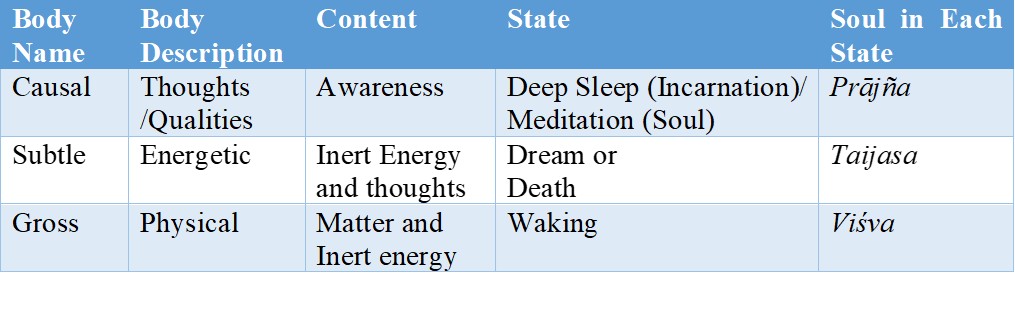
Thoughts or qualities in the awareness are called vāsanās or guṇas. A thought or quality is a form of awareness just as a golden ornament is a form made out of gold. Awareness always exists in the form of thoughts unless you achieve the state of pure awareness in perfect meditation by filtering out all thoughts. The causal body is also called as the individual soul or jīva. The pure awareness, devoid of any thoughts, is called the soul or ātman. The pure awareness is almost like the inert energy that produces it, except that the pure awareness is aware of itself while the inert energy is not aware of anything including itself.
We can also take this state of pure awareness (meditation) to be almost equal to the state of deep sleep. In deep sleep, awareness totally disappears since the nervous system takes rest. So, there is no question of assuming the existence of pure awareness in this state. If you want to say that pure awareness exists in deep sleep, you have to say that ‘deep sleep’ means the state ‘meditation’, in which pure awareness exists without any other thoughts. You can then say that pure awareness is the prājña that enjoys bliss in this assumed deep sleep state. The experience of bliss is the result of the nervous system being in the state of near-total rest in meditation. No energy is wasted in thinking various thoughts and so the resultant experience is of bliss. In the actual deep sleep, the nervous system is totally at rest and awareness is not even generated. So, experiencing bliss in deep sleep is out of the question. The person experiences bliss only upon awakening. So, it can be said that the pure awareness enjoys bliss in the brief moment just upon awakening, before various thoughts fill the mind.
Even though bliss is enjoyed by the soul in meditation as well as in the brief moment just upon awakening, such soul is not the source of this creation as told in the Veda. Taking the common point of enjoyment of bliss, you can’t equate soul with God because even the quantity of bliss differs between God (Brahmaananda) and soul (Maanushaananda). In order to remove this confusion, the Veda clearly introduced another difference, which is that God is the source of creation. Such different adjective clearly says that the soul is not the enjoyer in the deep sleep (since the soul is non-existent in deep sleep and does not experience bliss in deep sleep) but, the mediated God (Eshvara) is the enjoyer, who is omniscient with full unimaginable awareness. Unimaginable awareness means that such awareness is not the relative awareness, which is generated as special work form by inert energy in the functioning nervous system.
In the Veda, the prājña is described to be the awareness present as the witness during third state of deep sleep. But it is very important to note that the description applies only in the case of a Human Incarnation of God because God exists directly in the body of human incarnation. It does not apply in the case of an ordinary human being unless you stretch your interpretation to take Eshvara as the enjoyer since this tiny deep sleeping body exists as a part of the world-body of Eshvara. By such stretched interpretation, Shankara can be justified. But, this does not mean that the disappeared soul in deep sleep is God! In the Human Incarnation of God, apart from the three bodies made out of matter, energy and awareness, there is a fourth item, which is the unimaginable God. However, the unimaginable God does not directly enter into the human body of the Human Incarnation. The Energetic Incarnation of God known as Datta (Eshvara) enters the human body. The Energetic Incarnation has relative awareness that is generated from its energetic body. The unimaginable God (unimaginable awareness) has already merged permanently into the relative awareness of the Energetic Incarnation and the relative awareness of energetic incarnation is already the unimaginable awareness. The Human Incarnation, thus, not only has the awareness generated from its own nervous system, but it also has the unimaginable awareness of the Energetic Incarnation. The Energetic Incarnation is invisible and undetectable to us humans. It can be considered to be almost unimaginable. The relative awareness of the Energetic Incarnation, into which the unimaginable God has merged, is already having unimaginable nature.
So, the relative awareness of the Energetic Incarnation, along with the unimaginable God merged into it, are together considered to be the unimaginable awareness. This unimaginable awareness is present in the Human Incarnation, even during deep sleep, when the relative awareness generated from the human body (in which the relative awareness of first energetic incarnation is mixed) becomes absent. This remaining unimaginable awareness is the real Prājña, which is also described as the source of creation (Sarvasya yoniḥ) and as solidified knowledge (prajñānaghanaḥ) in the Veda. These additional descriptions of the Prājña in the Veda are true since the First Energetic Incarnation of God is the Creator of creation and He is omniscient. Thus, the Prājña in deep sleep, as described in the Veda, applies only in the case of the Human Incarnation.
Further, the Veda also describes a fourth state called turīya beyond these three states. It is the state of the absolute unimaginable God, who has merged into the relative awareness of the first Energetic Incarnation, but is fundamentally beyond matter, energy, awareness, space and time. This fourth state also can be discussed only in the case of the Human Incarnation, in whom the unimaginable God is present in a merged state. In an ordinary human being, this unimaginable God is not present. We have seen that the descriptions in the Veda related to the third and fourth states apply only to the case of the Human Incarnation. So, the first two states of the wakeful and dream states described in the Veda must also be in the case of the Human Incarnation alone because all the four states must refer to one case only. You can’t say that first two states (awaken and dream) belong to human being and the latter two states (Praajna and Turiiya) belong to God. The first two states can apply to human incarnation also without any problem. The taijasa is said to be the enjoyer or the witness of the dream state and the viśva is the enjoyer or the witness of the waking state. The essence of the above discussion is to realize that the four states described in the Veda refer only to the specific case of a Human Incarnation of God and not the case of an ordinary human being.
To be continued...
★ ★ ★ ★ ★
Also Read
Avidyaa And The States Of Consciousness (part-4)
Posted on: 23/02/2026Avidyaa And The States Of Consciousness (part-5)
Posted on: 26/02/2026Avidyaa And The States Of Consciousness (part-3)
Posted on: 21/02/2026Avidyaa And The States Of Consciousness (part-2)
Posted on: 18/02/2026
Related Articles
Shri Dattaguru Bhagavat Gita: Kaalabhairava Khanda: Chapter-15 Part-1
Posted on: 09/10/2018No Experience Exists In Deep Sleep
Posted on: 02/04/2014Knowledge Of Deep Sleep (sushupti)
Posted on: 28/10/2023Shri Dattaguru Bhagavat Gita: Brahma Khanda: Chapter-3
Posted on: 31/03/2018Jivatma Tattva Prakaranam (the Topic Of The Nature Of The Soul)
Posted on: 17/05/2022