Posted on 18 Feb 2026.  Share
Share

Note: This article is meant for intellectuals only
Part-1 Part-2 Part-3 Part-4 Part-5
SECOND PART
Interpreting the Four States for a Human Being
As per the theory of Śaṅkara, every human being is said to be Brahman (God) in an essential sense. So, every human being becomes an Incarnation of God. This, of course, is not true! Śaṅkara was forced to twist facts in His theory so as to encourage atheists to adopt His theory and become theists. So, in His commentary regarding these four states, Śaṅkara interpreted the Veda in the context of an ordinary human being, which, as per His theory, was assumed to be God in an essential sense. If this analysis of the four states is to be successfully conducted in the case of an ordinary human being, then a small adjustment is required in the context of the deep sleep state. We must take the term ‘deep sleep’ only in the sense of ‘meditation’. Only then can it be said that the soul is in a state of bliss in this state as stated in the Veda. In the actual state of deep sleep of an ordinary human being, the enjoyer himself is absent, since no awareness is generated. It is a state of total ignorance. If the word prājña is to be defined in this case, it can only be defined as total ignorance (pra+ajña). ‘Pra’ means completely and ‘ajña’ means ignorant. Prājña, therefore, means completely ignorant. In the case of an ordinary human being, the prājña, which is the witness in deep sleep, is of the form of total ignorance, since awareness itself is absent {the enjoyer as ‘I’ impression exits in the brain as inert pulse (spotha)}. Needless to say, this prājña is not omniscient, blissful or the source of creation as stated in the Veda.
Of course, we have no objection if you say that the soul enjoys bliss in the first moments of awakening, right after deep sleep ends. Such bliss, as mentioned earlier, is only the result of the well-rested nervous system resuming its function. Bliss is nothing but a lot of happiness having a maximum border called Maanushaananda, beyond which no human soul can withstand it. This bliss is experienced in the state when pure awareness alone exists and various other thoughts have not yet filled the mind. So, it is correct to say that the enjoyer of the bliss is the soul and not the individual soul. Recall that soul means pure awareness, which is devoid of thoughts and the individual soul means the awareness filled with thoughts and qualities. In the case of an ordinary human being, the individual soul exists in the first state, which is the wakeful state, where it is called viśva. It also exists in the second state, which is the dream state, where it is called taijasa. This individual soul itself gets transformed into the pure awareness or the soul during meditation. It is the same pure awareness, which exists in the very first wakeful moments after deep sleep, where it enjoys bliss. Later, it gets transformed into the individual soul as it gets filled with various thoughts.
The crucial point to understand here is that in the actual deep sleep, neither the soul, which is pure awareness, nor the individual soul, which is the thought-filled awareness, exists to enjoy anything. In this state, you can only say that the soul exists as inert energy (inert impression as ‘I’ in a special part of brain, called Chittam). During deep sleep, inert energy exists in the body also functioning in different cells, organs and systems as the body continues to live. Considering the soul as inert energy in deep sleep is acceptable because pure awareness is very similar to inert energy in the aspect of not having any thoughts. Pure awareness is devoid of all other thoughts except for the single thought of self-awareness. Energy, being inert, is devoid of all thoughts. The inert energy can be said to be the soul from another angle as well. The inert energy in the body is the cause of awareness. This awareness or the soul is a special work-form of the inert energy in a functioning nervous system. From this angle also, the soul can be said to exist as inert energy in deep sleep in a state of total ignorance. This is obvious since the soul here is nothing but inert energy. The Gita also describes this view of the soul being inert (Sthāṇuracalo’yam—Gita).
This basic inert energy exists in the actual state of deep sleep of an ordinary person. It is of the form of total ignorance and is called as prājña in the sense of complete ignorance (pra+ajña). Ignorance is called avidyā. In deep sleep, the possessor of body (enjoyer) is absent, who remains as inert pulse (Sphota) as ‘I’ only in brain. Hence, all the inert body (Shariiram) in this state is without possessor of body (Shariiri) becoming a tiny part of this whole world for which the possessor is mediated God or first energetic incarnation (Eshvara). This tiny inert body can claim God as its possessor, called Praajna, the source of world. This is limited to deep sleep only and not to awaken and dream states in which the normal individual soul exists as enjoyer. In this way, you can interpret God as enjoyer and ignorance as the existing body in deep sleep. But, the enjoyer (God) and the body (ignorance) are disconnected (because the mediated God did not merge with ordinary human being) and you can’t claim this tiny ignorance in the deeply sleeping body as the body of the Almighty. It is like an inert nail or hair present in the human body in awaken state.
The omniscient God can’t be said to have ignorance as body, which is not known to Him. If it is known, God is not covered by the ignorance-body. Hence, the Veda assigned awareness as body of God in the deep sleep and not the ignorance. You can’t say that the inert nail is the body of the soul in the awaken state! Awareness, inert energy (with awareness) and matter (with awareness and inert energy) are the materials of deep sleep, dream (death also) and awaken states respectively. All these three states are related to human incarnation whereas dream and awaken states are only related to the ordinary human soul. The deep sleep state is also related to the ordinary human being if we take inert ignorance as the material of the deep sleep instead of awareness. Regarding deep sleep three points appear. 1) Total ignorance in which the enjoyer-soul is also absent. 2) Unimaginable awareness-God alone exists as the world-body possessor as enjoyer. 3) Ignorance (avidyaa) is the causal body for the non-existent soul and not the causal body of God since ignorance is totally absent for God.
When the soul does not exist as awareness and remains as inert energy only, this inertia (avidyaa) becomes a tiny part of world and the world exists as body of God. This avidyaa can be assumed as a tiny part of the body (world) of God. Since relative awareness is absent in deep sleep, only unimaginable awareness (God) is leftover as the enjoyer. In the case of human incarnation, such God exists directly in the tiny inert body remaining with avidyaa alone. This Avidyaa or non-awareness or inertia stands for inert energy that can be material cause of the world, which was created by the unimaginable God as the first item surrounding Him as His body. But, this situation is in the case of unimaginable God only just in the beginning of the creation. Such situation can’t be referred here now when the created world is existing. If we treat the whole universe as inert energy only in all states (because awareness is also a special work form of inert energy only), we can say that avidyaa is the body of the first energetic incarnation. In such argument, the difference between relative awareness and inertia disappears since relative awareness is also basically inert energy only.
The relative awareness is generated in due course of creation from five inert elements only and hence, can be treated as inert energy only. In the dream state, this soul or inert energy is converted into the individual soul, which is a bundle of thoughts. These thoughts are from sub-conscious state that contains strong ideas (Vaasanas) of previous births as well as present birth, which cause dream. The individual soul in the dream state is called the taijasa. The taijasa exists in a body of inert energy alone, which is called the subtle body. It does not interact with the gross body made out of combination of matter and energy while the dream is going on. In the wakeful state, the same individual soul, exists in body of matter and inert energy, which is the gross body.
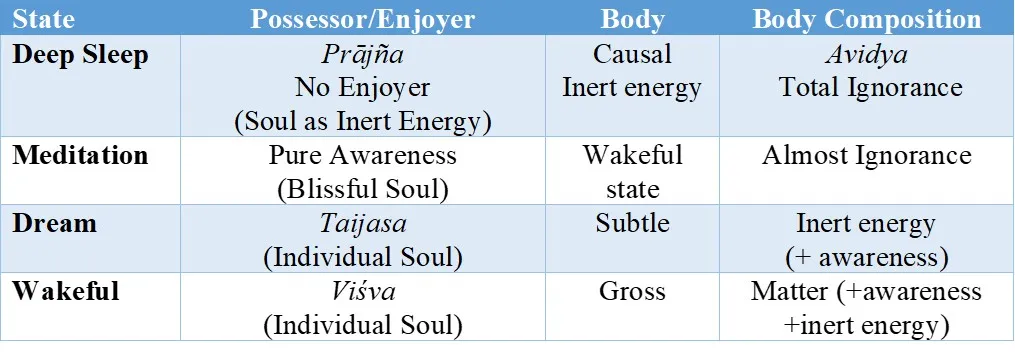
The individual soul in the wakeful state is called the viśva. Here, we must note that in the wakeful state, the viśva, which is aware, interacts with matter and inert energy. In this state, awareness, matter and inert energy are present together. Yet, this state is identified only by the additional appearance of matter compared to the dream state (in dream state awareness and inert energy exist together without any contact with matter of gross body). Similarly, in the dream state, the taijasa, which is aware, interacts with inert energy only. In this state, awareness and inert energy are present. Yet, this state is identified by the additional appearance of inert energy compared to the deep sleep state. In the third state of deep sleep, the prājña of the ordinary human being is total ignorance or avidyā and it represents the causal body (because non-aware ignorance is inert energy, which is the cause of the world). The living gross body consisting of matter and energy exists throughout all three states. But, it is not considered in the deep sleep and dream states since it is not grasped by the enjoyer (taijasa) of the dream state and also non-existing enjoyer of the deep sleep state called prājña. The Praajna remaining as the inert energy is fully inert in deep sleep. The gross body is grasped only in the wakeful state by the viśva, which is the enjoyer of that state. Hence, the gross body is considered only in the wakeful state.
Table 2: The enjoyers in the states of consciousness of an ordinary human being.
Let us analyze the subtle body of the dream state and the causal body of the deep sleep state more carefully. The subtle body is made of inert energy and the possessor of that subtle body is the individual soul existing as a bundle of thoughts. The individual soul is having thoughts, thus, means the mind. The individual soul enters into the subtle body in the dream state as well as in the state of death. The Veda describes the state of death as that in which the individual soul made of mind leads the living subtle body away (Manomayaḥ Prāṇaśarīranetā). Manas or manaḥ means mind. The word manomayaḥ means that the individual soul itself is a modification of mind. The suffix ‘-maya’ in manomaya comes from the Sanskrit word mayaṭ. Mayaṭ is used here in the sense of modification (vikāra). So, the individual soul and the mind are not two different items. Mind itself is modified into the individual soul. This individual soul acts as the possessor (śarīrī) of the subtle energetic body (sūkṣma śarīram). This energetic body is also called as the prāṇa śarīram since it is alive. Prāṇa means life. The subtle body is alive due to the presence of awareness in it, which is in the form of the individual soul.
The relative awareness can be considered as inert energy, in which case the entire world with relative awareness and relative inert items can be considered as non-aware ignorance or avidyaa only. The mediated God with whom unimaginable God merged can be alone considered as absolute awareness or unimaginable awareness. In this way, God is the possessor of the body made of avidyaa. This state exists always irrespective of deep sleep. You can’t consider the deep sleep alone as avidyaa because the state of deep sleep is not continuous all over the earth since one side is awaken daytime and the other opposite side is deep sleep night time. Hence, you can’t have either awaken state or deep sleep state alone all over the earth at anytime. This means that the world-body of God (Vishvaruupa) is always partly in awaken state and partly in deep sleep state at any time. However, if you consider that the world-body always contains relative awareness (chit) and relative inert items (achit) and if you maintain the difference between relative awareness and relative inert items, you can’t get all the world in inert state alone at any time. In this concept, the entire world never becomes avidyaa due to the presence of non-inert relative awareness in the world at any time.
Thoughts are called vāsanās. Due to close association of the subtle body with the individual soul, the subtle body in a dream or after death can also be said to be vāsanāmaya. Vāsanāmaya means that which is permeated (pervaded) by the individual’s bundle of thoughts. In the wakeful state, even the gross body can be roughly said to be vāsanāmaya due to its close association with the individual soul. The thoughts are made of nervous energy and the subtle body is made of inert energy. Mixing of nervous energy with inert energy (subtle body) is very easy and hence, subtle body can be perfectly called as Vaasanaamaya. The gross body contains matter predominantly and is less prone to mix with nervous energy. Thoughts (vāsanās) are forms of awareness. They cannot exist independently without a body of matter or energy, which acts as a container of the awareness. The body could be made out of matter and energy, as in the wakeful state or it could be made only out of energy only, as in the dream state and in the state after death.
The subtle body cannot be treated to be just a bundle of thoughts. It must be considered to be made of inert energy, which is pervaded by thoughts. In other words, the subtle energetic body (śarīram) is the container and the bundle of thoughts, which is the individual soul, is the contained (possessor of body or Shariirii). In this context, the possessor of body (contained) is always internal to the possessed container.
Opponent:- You said that Vishishta Advaita means that both the mediated God or Vishvaruupa (Sthula Chidachit Vshishta) is the same human incarnation (Sukshma Chidachit Vishishta) because the word Advaita or monism means that both Eshvara and human incarnation are exactly one and the same. But, in the case of Eshvara’s world-body total ignorance never exists since as some are in deep sleep some others are awaken. In the case of human incarnation’s body, there is total ignorance since all the relative awareness is absent. This is the difference between the two cases even though the merged unimaginable God is always with omniscient unimaginable awareness and is common to both cases.
Swami:- In both cases, the omniscience of the common unimaginable God about every place of His body (world) is one and the same and this common point is the meaning of monism (Advaita) in the word Vishishta Advaita. Moreover, the unimaginable God in the world-body as well as in the tiny body (in the case of human incarnation) is one and the same since God is beyond space having the same omniscience. What I mean exactly here is that the unimaginable God present in the world-body as well as in the tiny body is aware of the entire world. This means that the world is also the body of the unimaginable God present in the tiny body also. In such case, where is the difference in the body of the unimaginable God present in the world-body as well as in the tiny body. World is common body to both Eshvara and human incarnation. You can’t limit the unimaginable God of the tiny body (of the human incarnation) to that tiny body only. When the omniscience is a common point, the world-body must be also a common point.
To be continued…
★ ★ ★ ★ ★
Also Read
Avidyaa And The States Of Consciousness (part-4)
Posted on: 23/02/2026Avidyaa And The States Of Consciousness (part-5)
Posted on: 26/02/2026Avidyaa And The States Of Consciousness (part-3)
Posted on: 21/02/2026Avidyaa And The States Of Consciousness (part-1)
Posted on: 16/02/2026
Related Articles
Shri Dattaguru Bhagavat Gita: Kaalabhairava Khanda: Chapter-15 Part-1
Posted on: 09/10/2018No Experience Exists In Deep Sleep
Posted on: 02/04/2014Shri Dattaguru Bhagavat Gita: Brahma Khanda: Chapter-3
Posted on: 31/03/2018Knowledge Of Deep Sleep (sushupti)
Posted on: 28/10/2023How Can You Say That Dream Is Real?
Posted on: 30/11/2022