Posted on 23 Feb 2026.  Share
Share

Note: This article is meant for intellectuals only
Part-1 Part-2 Part-3 Part-4 Part-5
FOURTH PART
Five Items in the Process of Knowing
Knowing is an action. In the context of any action, including the action of knowing, there are five items. They are the kartā or the doer of the action, the karma or the object on which the action is done, the karaṇam or the instrument with which the action is done, the kriyā or the process of doing itself and the kriyā phalam or the fruit of the action. Let us try to identify what these five items exactly are in the case of the action of knowing. The kartā or the doer in the context of knowing is the knower. This knower is the person’s self-identity or the I-thought. It is also called pure ego (śuddha ahaṅkāra). The karma or the object is the object to be known. The karaṇam or the instrument used to know is the brain and the nervous system. The kriyā is the actual process of knowing. Finally, the kriyā phalam is the knowledge gained by the knower, which is the result of the process of knowing. Let’s take a detailed look at these five items in the specific cases of the unimaginable God, an ordinary soul and the mediated God.
Case of unimaginable God
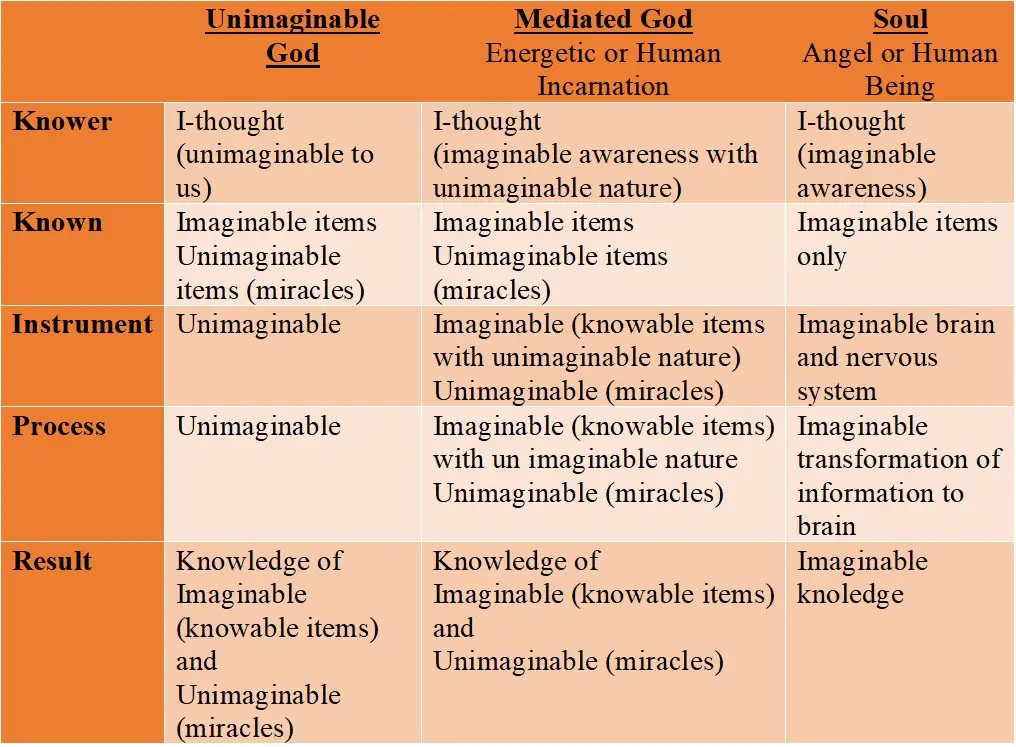
In the case of unimaginable God, the knower is the I-thought, which represents the self-identity of God. This might appear to be similar to the case of the soul, but actually this knower, in the case of God, is unimaginable. The known, or the object to be known, can either be imaginable or unimaginable since God can know items from both the imaginable and unimaginable domains. The instrument by which the process of knowing is done is unimaginable. There is no material brain and nervous system in the case of God and His awareness is not a form of energy, since it existed before the creation of energy. Since the instrument is absent in God’s case and yet, the process of knowing is done, the instrument must be unimaginable. Also, since the instrument capable of doing the process of knowing is absent in God’s case and yet, the process of knowing is done, the process too must be unimaginable. The result of the process, which is knowing the object or the knowledge gained by God about the object is imaginable. The object of the process of knowing might be imaginable or unimaginable. But we can imagine or know that the unimaginable God is knowing the item. God knows both the imaginable creation as well as the mechanism behind unimaginable events called miracles.
Case of the imaginable soul
In the case of the imaginable soul, the knower is the I-thought, which is just an impression within awareness. Awareness itself is nothing but nervous energy. So, the knower in the case of the soul is imaginable. The object to be known can only be an item of the imaginable world. It cannot be an unimaginable item such as the mechanism behind a miracle. The instrument by which the process of knowing is done is the brain and the nervous system, which too is imaginable. The process of knowing is, of course, imaginable since the process of knowing is merely the transfer of information to the brain and within the brain by the activity of neurons. The result of the process of knowing is the attainment of knowledge of the knowable item of the imaginable creation. This, obviously, is also imaginable in the case of a soul.
If you compare the unimaginable God and the imaginable soul, there are only two similarities: The first is that if the object to be known belongs to the imaginable creation, it can be commonly known in both cases. The second is that the result of the process of knowing the imaginable object (not the unimaginable object), which is the attainment of the knowledge of the object, is common in both cases. The first similarity is partial in the sense that the objects that can be commonly known by both are only knowable objects. Unknowable or unimaginable objects are not known by the soul but they are known only by God. The second similarity is also partial since the knowledge that is gained commonly by both is only the knowledge of knowable objects. The knowledge about unimaginable objects cannot be gained by the soul. Two halves might add up to one, but here, you cannot assume that these two partial similarities add up to a complete similarity. So, you can never say that God and the soul are identical!
Case of the mediated God or the Incarnation
We can similarly analyze the case of Īśvara who is the mediated God. Mediated God means the God, who has entered the body of either an energetic being or a human being. This analysis, thus, applies to both Energetic and Human Incarnations.
Knower: The knower or the I-thought is an impression within the awareness of the Incarnation. This I-thought and the awareness is very much common to both an ordinary soul and the mediated God. In both cases, this awareness is the relative awareness, which is a specific work-form of inert energy in a functioning brain and nervous system. This relative awareness, in both cases, is essentially made up of energy. The relative awareness requires a body which acts as its container and this fact commonly applies to both the mediated God and a soul. For ordinary souls, the relative awareness is found only in souls present either in a material human body or in the energetic body of an angel. It is never found existing independently outside of a body. Similarly, for mediated God, the relative awareness is found only in a Human Incarnation or an Energetic Incarnation. Apart from this similarity, there is an important difference between an ordinary soul and the mediated God. Unimaginable God has merged with the relative awareness in the mediated God. So, the relative awareness of the mediated God has become the absolute unimaginable awareness by its nature. The relative awareness of the soul, on the other hand, always remains the relative awareness alone since there is no merge of unimaginable God.
Known: For both the soul and the mediated God, any knowable item of this creation can commonly become the object to be known. Apart from this similarity, there is also a difference. Since the mediated God has become the unimaginable God due to perfect merging, He can even know the mechanism of miracles. It means that for the mediated God, the unimaginable item can also become the object to be known.
Instrument: The instrument used for knowing is the brain and nervous system in the case of human beings, who are souls present in a material body. In the case of angels, who are souls present in energetic bodies, a corresponding energetic mechanism produces the awareness. Although this mechanism is not known to us, it is some imaginable mechanism only, not yet known and the tool of such mechanism is knowable but, not yet unknown. So, in the case of a soul, the tool of imaginable mechanism, which produces awareness and enables thinking, is the instrument that is known to us, which is brain and nervous system. The human and energetic Incarnations also have identical mechanisms for producing the relative awareness as human and energetic souls. But the difference is that this instrument in the mediated God, which is knowable but, not yet known, has also become unimaginable due to the merge of unimaginable God with the instrument also. As a result, the Incarnation can even understand unimaginable miracles. The soul, whether present in a human body or an energetic body, can never understand miracles since the unimaginable God has not merged with it.
Knowing: The process of knowing is common in both a soul and the mediated God due to presence of the common relative knower, relative instrument and relative process of knowing. When the object to be known is in the unimaginable domain, all these three (knower, instrument and process) are also having unimaginable nature due to the merge with unimaginable God and the knowledge of unimaginable item is attained by the unimaginable knower present in the body of incarnation. When the object is in the imaginable world, these three can know the imaginable object through their relative imaginable nature itself in the case of mediated God. The mediated God knows how unknowable miracles take place. We cannot imagine how He could know this unimaginable mechanism behind miracles. We know that the relative awareness of a human or energetic being is not capable of knowing an unimaginable item. Since, the mediated God knows this unimaginable item, His process of knowing it must also be unimaginable. In the mediated God, the knower, instrument as well as the process of knowing have acquired this unimaginable nature due to the merging of the unimaginable God with the medium.
Result: The result of the process of knowing a knowable object is the knowledge or understanding of that object, which is common to both cases. The difference between the two arises in the result of the process of knowing an unimaginable item, such as the mechanism behind miracles. The mediated God attains the result, which is the knowledge or the understanding of the mechanism behind miracles. But this result or knowledge is unimaginable to us. Thus, the result can be imaginable or unimaginable in the case of the mediated God corresponding to the imaginable or unimaginable objects respectively. The result of the process of knowing can never be unimaginable for a soul and hence, the soul always knows imaginable items.
Table 3: Comparison between the parts of the process of knowing in Unimaginable God, mediated God and a soul
From this analysis of the process of knowing, we find that there is no essential difference between unimaginable God and mediated God. This is due to the unimaginable nature acquired by the mediated God due to merge of unimaginable God. The case of the soul is very different from these two. Pointing at just one superficial similarity, we cannot equate the soul with God. The soul and God are totally different and this fact remains true whether we consider unimaginable God or mediated God and whether we consider a soul present in an energetic or material body.
Avidyā
Avidyā means ignorance, which may be total or partial. Let us examine ignorance in various states in order to decide if it can be considered as the causal body.
Total ignorance
Deep sleep is the state of total ignorance during which the knower himself is absent. The knower is the alive or aware I-thought, which is called as the pure ego or śuddha āhaṅkāra. This I-thought is basically an impression of awareness. In deep sleep, awareness itself is absent and hence, the I-thought, which is its impression is also absent in the sense that it is not alive being an inert nervous impulse stored in memory chip (chittam). The impulse or the stored impression is inert; it is not awareness. It is just like storing information on the memory chip of a device. The information remains stored even when the device is switched off and no power is supplied to the device. When power is supplied, the information from the chip is displayed on the screen. Similarly, when awareness is produced in the brain upon waking up, the I-impression stored in the brain expresses as the I-thought or pure ego. In other words, the person is able identify himself. The I-impression stored as nerve impulses in the brain is only inert and cannot be called as the knower. This inert stored impression is as good as any inert part of the living body that exists during deep sleep. So, this ignorance in deep sleep is the total ignorance that is based on non-awareness.
Partial awareness
This second type ignorance is the partial ignorance that is based on awareness. It is the ignorance that exists when the person is aware. Let’s look at these types of partial ignorance depending on the state of awareness or condition of the person.
Meditation: In meditation, the person is awake and aware. But there is only the I-thought in the person’s awareness. All other thoughts and impressions are stored in the memory as inert pulses only. They are inert and not expressed in the awareness. The inert energy spent in generating this meditative awareness is very minimal. Since most of the brain’s energy is preserved and not exhausted in expressing various thoughts, this meditative state is blissful due to preservation of energy.
This state differs from the state of deep sleep in which no awareness is generated and the entire inert energy in the brain is preserved. As a result of saving energy for a long time in deep sleep, the person experiences full bliss in the first moments of wakefulness. No bliss can, of course, be enjoyed in deep sleep since there is no awareness. In meditation, most of the brain’s inert energy is preserved and the bliss enjoyed is almost the maximum. The knower ‘I’ is totally absent in deep sleep. In meditation, the knower ‘I’ is present but no objects are being known. The I-thought alone exists in the awareness during meditation. This maximum happiness within the limits of human level happiness (maanusha aananda) is called as bliss, which is not the ultimate happiness of God or the real bliss (Brahma aanada), but is called relatively bliss being the highest level of human happiness.
Wakeful state: In the wakeful state, various thoughts or impressions are active in the awareness, including the I-thought. Almost all the inert energy that is available for being converted into awareness, is spent in expressing these thoughts or impressions. Due to the high expenditure of energy, bliss is impossible. In this state, the person has the ignorance of items that are forever unknowable to the person along with items that are unknown to the person so far.
If one says that avidyā or ignorance is the causal body of the soul, such a causal body exists only in the wakeful and meditative states. But there is some difference in the ignorance in both these states. In meditation, the ignorance is a forced ignorance since thoughts are suppressed and they do not get expressed in the awareness. In the wakeful state, there is no suppression of the thoughts. However, due to the limited capacity of the mind, the presence of several thoughts in any given time, naturally leads to the suppression of other thoughts. The thoughts that are not in the person’s awareness at a given time represent the ignorance of the person during the wakeful state. In both the meditative and wakeful states, the ignorance of unknowable items and items that are unknown so far, is common.
A person sees a rope in dim light or partial darkness and mistakes it to be a snake. The ignorance of the rope is the partial ignorance that is based on awareness. The ignorance of rope as well as the awareness of the snake exist together. This ignorance is totally different from the total ignorance in deep sleep, which is based on non-awareness. In deep sleep, even the knower or the I-thought is absent. The absence of the knower is clearly supported by experience in the case of the deep sleep (experiencing immediately after deep sleep) of an ordinary soul. Even the single I-thought of meditative awareness disappears in deep sleep. The I-thought never disappears only in the case of God. In fact, there is no possibility of deep sleep for either the unimaginable God or the God-component in the mediated God (In energetic being also, there are no dream and deep sleep states.) and naturally, the absence of the I-thought is also impossible. But, for a soul, the I-thought most certainly vanishes completely in deep sleep. This argument itself is sufficient to demolish the false point that every soul is already God.
However, it does not prevent a specific soul from becoming God, which is the case of the mediated God or an Incarnation. But the soul becomes an Incarnation only by the will of God and no effort made by the soul can make the soul an Incarnation. The case of the mediated God, is not at all different from the case of unimaginable God as said above. The relative awareness in an Incarnation is not affected by deep sleep since the relative awareness has already been converted into absolute awareness due to merge by unimaginable God. The relative awareness in an Incarnation belongs to the soul-component. It disappears during deep sleep. But the absolute awareness from the God-component still exists. It is ever-awake and present as the omniscient and omnipotent ‘I’ even during the deep sleep of the soul-component. In the case of the awareness of mediated God, the temporariness of the relative awareness and the permanence of the absolute awareness are like two sides of the same coin. Due to the conversion of the relative awareness of the mediated God into absolute awareness and its constant existence as the omniscient and omnipotent ‘I’ or self-identity, there is no trace of ignorance or avidyā.
Avidyā exists only for a soul. It is the soul’s ignorance of the unimaginable God, its ignorance of the mechanism of God’s miracles and its ignorance of many items even in the imaginable creation. The soul’s knowledge is highly limited and it does not even know the entire creation. But unimaginable God, whether mediated or non-mediated, is omniscient. He knows all items in creation including all souls, apart from knowing Himself and His miracles. The world which is actually non-existent for God, appears to be existent to Him by His will and not as a result of His ignorance. Here an opponent raises a point.
Opponent: A non-existent snake appears to exist due to the ignorance of an existent rope. If the existent item appears, the non-existent item will not appear. Hence, God assumes ignorance in order to be able to see the unreal world.
Swami: Avidyā is real ignorance, which is associated only with a soul (Avidyāvachinno jīvaḥ). Māyā is assumed or artificial ignorance and is associated only with God (Māyāvachinna Īśvaraḥ). Artificial ignorance is not real ignorance. It is a self-imposed ignorance. Māyā is not a real ignorance because of which the non-existent world appears real to God. The non-existent world appears to be existent to God due to His unimaginable power called maayaa. Avidyā or real ignorance, confined to the soul only is the reason for the non-existent snake to appear in place of the real rope. Due to avidya, the snake, which is the appearance, seems to hide the rope, which is the reality. Both the rope and the snake are items of the imaginable world alone. So, this case is different from the case of creation. We cannot say that for a soul, the world is only an unreal appearance and that in reality it is non-existent. The world is very much real to the soul as per the experience. The word māyā does mean non-existent in all angles, but it is non-existent only to God and not to the soul. One meaning of māyā is that which is non-existent (Yā mā sā māyā). If you mean world (effect or kaaryam) as maayaa, it is non-existent being different from God. If you mean the unimaginable power (cause or kaaranam) as maayaa, it means the same unimaginable God. The world thus is actually non-existent for God. But it appears to be real to God by His unimaginable power and not due to His ignorance. In reality of appearance of non-existent world, there is no difference between God and soul. If the creation is equally real with God, God can’t be the creator since one absolute reality can’t create another absolute reality.
The case of the soul is completely different since the soul itself is very much a part of this world. If the world had been non-existent to the soul, then the soul itself would be non-existent to itself! The word māyā has another meaning. It also means wonderful (Maya vaicitrye). It is this meaning of the word that applies to the case of the soul. The first meaning of māyā as that which is non-existent applies only in the case of God. God created this wonderful world. Since it is created by God, it is not a wonder for Himself! So, the meaning of māyā as a wonder does not apply to God. Māyā is controlled by God alone (Māyīnaṁtu Maheśvaram— Gita). This māyā or unimaginable power of God (in the causal sense) is not even understood by the soul (Mama māyā duratyayā). This creation of God is also said to be māyā (in the sense of effect) in the Gita (Māyāṁ tu prakṛtim viddhi). It can be said to be māyā for both, God and the soul, but in different senses. For God, creation is māyā in the sense that it is non-existent. For the soul, creation is māyā in the sense that it exists and is wonderful. Apart from these two senses (non existence and wonderful) the above said two senses (as cause and effect) also exist and unless you are careful about these four angles, in a given context, you will fall in maayaa (confusion) to understand the word maayaa!
It is also said in the Gita that the unimaginable God merges with an imaginable item of imaginable creation. (Prakṛtim svām... Ātma māyayā). The unimaginable God thus becomes the mediated God due to His unimaginable power or māyā or due to Himself (as cause). The merging of the unimaginable God with an imaginable item is unimaginable. Hence, this process of merging is said to occur by God’s māyā (or Himself as cause), which means that it is wonderful to us (sense of wonder). Even though māyā is non-existent (yaa maa) for God, there is no place for ignorance or wonder in God. The world even though non-existent for God, also simultaneously really appears as full reality (as appearing to soul) to Him due to His unimaginable power. In natural example for the soul, non-existent appears real due to ignorance. But, unimaginable God is beyond natural phenomenon so that non-existent appears as real due to unimaginable power of God even without ignorance. It (world in sense of effect) is also fully under His complete control at all times. This is not the result of ignorance but it is due to His wonderful power, which is beyond our imagination. The unimaginable God remains unimaginable for any soul due to His unimaginable (wonderful) nature or power (Yogamāyāsamāvṛtaḥ— Gita). The Veda says that the unimaginable God, due to His unimaginable (wonderful) power, appears in different forms without being divided (Indro māyābhiḥ pururūpa...). However, the soul cannot appear in different forms without being divided since the soul does not possess any such unimaginable power or māyā. Hence, soul is not already God.
The unimaginable power is māyā and the unimaginable God, who is its possessor is the Māyī. Since there cannot be more than one unimaginable item, both māyā and God are one and the same. Māyā or God is the root cause of this world. Māyā is God’s unimaginable power, which is not different from God. The Gita says “Māyām tu prakṛtim...”, which means “Māyā is prakṛti.” Prakṛti means creation. Creation is wonderful and hence is Maayaa. Maayaa is creation in the sense of effect. Māyā is God’s unimaginable power, which is not different from Him in the sense of cause. This statement can be interpreted in two ways:- The first interpretation is direct in which the unimaginable power, māyā, can be regarded as creation or prakṛti itself i.e. māyā is creation itself (in the sense of effect). In this case, it is implied that God is the Māyī, who is the possessor and controller of māyā. The same unimaginable power, māyā, appears to God as an apparent but fully real creation. To souls, it simultaneously appears to be a really real creation i.e. it gets modified into the real creation that we see, in which we are a part and parcel. The second interpretation is that māyā is the root cause of prakṛti or creation. This is acceptable as per Sanskrit grammar (Tadadhīna Prathamā). In this case, the unimaginable power, māyā, which is the root cause or controller of creation, is not treated to be different from the unimaginable God, who is the Māyī. In this second sense, the word prakruti is taken in the second sense to mean the root cause (Prakṛtirmūlakāraṇe) as allowed by the dictionary. The primary sense of prakruti word is creation.
Let’s return to the concept of avidyā being the causal body. Avidyā can be said to be the causal body of the soul, but that too in the state of meditation alone and not in the state of deep sleep. Clearly, the idea of avidyā as the causal body does not apply in the case of God. Be it the case of the unimaginable God or the mediated God, God has no ignorance or avidyā. In the case of God, the causal body can be said to be māyā and not avidyā. You can call avidyā to be God’s causal body only if you misrepresent māyā, which is God’s artificial ignorance, to be avidyā, a real ignorance. But it would only be a misrepresentation and would not be valid since Maayaa is the power with full awareness and avidyaa is simply the ignorance, which is the absence of knowledge like darkness being the absence of light.
To be continued…
★ ★ ★ ★ ★
Also Read
Avidyaa And The States Of Consciousness (part-5)
Posted on: 26/02/2026Avidyaa And The States Of Consciousness (part-3)
Posted on: 21/02/2026Avidyaa And The States Of Consciousness (part-2)
Posted on: 18/02/2026Avidyaa And The States Of Consciousness (part-1)
Posted on: 16/02/2026
Related Articles
Datta Parabrahma Sutram: Chapter-11 Part-2
Posted on: 29/10/2017Monism And The Vedantic Unification
Posted on: 15/07/2019Why Is Every Soul Not God? Part-7
Posted on: 11/07/2021Swami Answers A Question Of An Advaita Follower On Brahman And Parabrahman (part-6)
Posted on: 17/04/2026Chidaatmaa And Chidaabhaasa - Part-3 Of 4
Posted on: 10/11/2020