Posted on 09 Jun 2026.  Share
Share
1. What is meant by the unimaginable power of unimaginable God?
[Smt. Chhanda asked:- Padanamaskaram to my most beloved Swami. Following are some fundamental doubts that came out in our everyday satsanga group discussion. All the doubts are related to different types of incarnations and Your explanation in the online satsanga of Datta Jayanti, 2025. We are not able to explain them through proper logic. I request You to kindly clarify them.
What is meant by the unimaginable power of unimaginable God? Is it the power to do creation, sustenance and destruction? Is it the capability to do miracles? Is it power to give exceptional divine knowledge? Is it His capability to do anything and everything that is omnipotence maintaining the justice always? Or is it the same as the power/energy we observe in this world (inert energy)? But in my view, power is always inert, be it imaginable or unimaginable. Magnitude only changes or it is differing quantitatively. God can give it any form. Is it not?]
Swami replied:- The power of God is not inert energy. The power of God is omnipotent and hence has all the characteristics of awareness. You have given different names to the fields in which the same power is working. The various forms of inert energy are electricity, light, heat, magnetism etc. Similarly, you have given names of various forms of the inherent power of God. Inert energy is an item that is created by this unimaginable inherent power of God. The solidified or condensed substratum or possessor of power is God like the sun and the sunlight is called the power of sun. Sun is a concentrated source of hot-light and sunlight is the dilute hot-light. This is the line of Vedanta, which gives importance to God (Brahman/ Parabrahman). It is based on the values of already existing items like the sun and sunlight or the Unimaginable God and His Unimaginable Power. In this line, we don’t analyze the formation of items. We take the item as it exists and give its value. The other line is the line of Śākteya, which gives importance to the Power (Mahā Māyā). It is based on the analysis of the formation of sun and sunlight. Both sun and sunlight are made of one item only, which is hot-light. Since hot-light is power, we immediately say that there exists only one item called power and therefore, there is no God or Brahman and there is only one item called Śakti or Power. Either Vedanta or Śākteya line of thought would have been correct provided it is proved that God is the condensed possessor of worldly energy (sun or concentrated hot-light) and His Power is the diluted worldly energy (sunlight or diluted hot-light).
The point that there is no qualitative difference and there is only quantitative difference between God and His power is also a point of worldly logic that exactly applies to sun and sunlight. Based on this quantitative difference, the Vedanta says that God (sun) is higher than His power (sunlight). You cannot oppose them. But, the crucial point here is that hot-light, sunlight and sun – all three are imaginable items. Unimaginable Power or Mahā Māyā and Unimaginable God or Parabrahman are unimaginable items, which means that the material of these items is completely unknown to us forever. You cannot bring a relationship among imaginable worldly items and superimpose that relationship on unimaginable items. Moreover, any number of unimaginable items result in one unimaginable item only. Since the material with which these three unimaginable items are made is unimaginable, we cannot say that such an unimaginable material is of three types and we have to conclude that such material is only one type. Due to this analysis, we have to say that such unimaginable material is only one under any circumstances, which may be called as Unimaginable Power or Mahā Māyā or Parabrahman as per the fascinations of corresponding schools. There is no space for a scientist to differentiate one item from another item in the unimaginable domain. Hence, all your questions get only one answer, which is that all different types of powers, actions, wisdom, items etc., are one and the same in the unimaginable domain. Imaginable domain is totally different giving space to the existence of all different items, powers etc. The imaginable domain is creation and the unimaginable domain is the creator. The imaginable domain is created for the entertainment of the unimaginable domain. In the imaginable domain, dualism and pluralism appear to make the entertainment more tenable and delightful.
2. Can we differentiate between the possessor of power and the power within the imaginable domain?
[In the Satsanga, You said: “In the manifested state, we can distinguish between Parabrahman (God) and Mahaa Maayaa (God’s power).” What exactly does this mean? Can we truly differentiate between the possessor of power (God) and the power itself (Mahaa Maayaa) within the imaginable domain? If such a distinction is possible, how can it be understood or identified? Please explain this clearly with a suitable example.]
Swami replied:- In the unimaginable domain, the soul (all of us) does not exist. How can you speak about the difference between Parabrahman and Mahā Māyā when both are unimaginable items resulting in one unimaginable item only? Perception requires your presence at that time. In the unimaginable domain, no soul is present. When you see the smoke coming out from the fire in the kitchen, you are noting that the cause of the smoke is the fire. But, when you observe smoke coming from the fire from the top of the hill, you are inferring fire with the help of the present smoke. Hence, the relationship between fire and smoke need not be seen by you. Inference can give information about the past. The fire on the top of the hill was present for a long time before you saw the down-coming smoke. Therefore, the information about the unimaginable domain, which was existing from the longtime can be inferred by the souls existing at present.
We are born in imaginable domain. We are part of imaginable domain or creation. In the creation, both God and Mahā Māyā are the incarnations of the same resulting one unimaginable item, which is the single actor expressed in two roles. These two roles are part and parcel of the creation as two media, but inside, the two roles exist as one actor called God (Parabrahman) or Mahā Māyā. In the unimaginable domain, the item is God or Mahā Māyā. In the imaginable domain, the item is God and Mahā Māyā based on the two differently expressed media-roles. You should not mix these two roles with the creation completely because these two roles have basic divinity due to the internal single actor called either Parabrahman or Mahā Māyā. The souls created by God (Parabrahman or Mahā Māyā) can see both Rādhā (incarnation of Mahā Māyā) and Krishna (incarnation of Parabrahman) separately. The souls are different from incarnations because souls are created by God, whereas the two divine roles as the incarnations are the same souls merged by the same God (call the God as Parabrahman or Mahā Māyā).
3. Do we need to treat the unimaginable power as non-inert only?
[With reference to the first reply, I request one more clarification. In the 2nd para, You are starting with the sentence "The point that there is no qualitative difference and there is only quantitative difference between God and His power is also a point of worldly logic that exactly applies to sun and sunlight." Here, I could not follow it as my question was only to know whether there is a quantitative difference between the unimaginable power and the inert power of the imaginable domain. What I understood is that since unimaginable power is not different from the unimaginable God, we need to treat the unimaginable power as non-inert only. Please clarify this.]
Swami replied:-
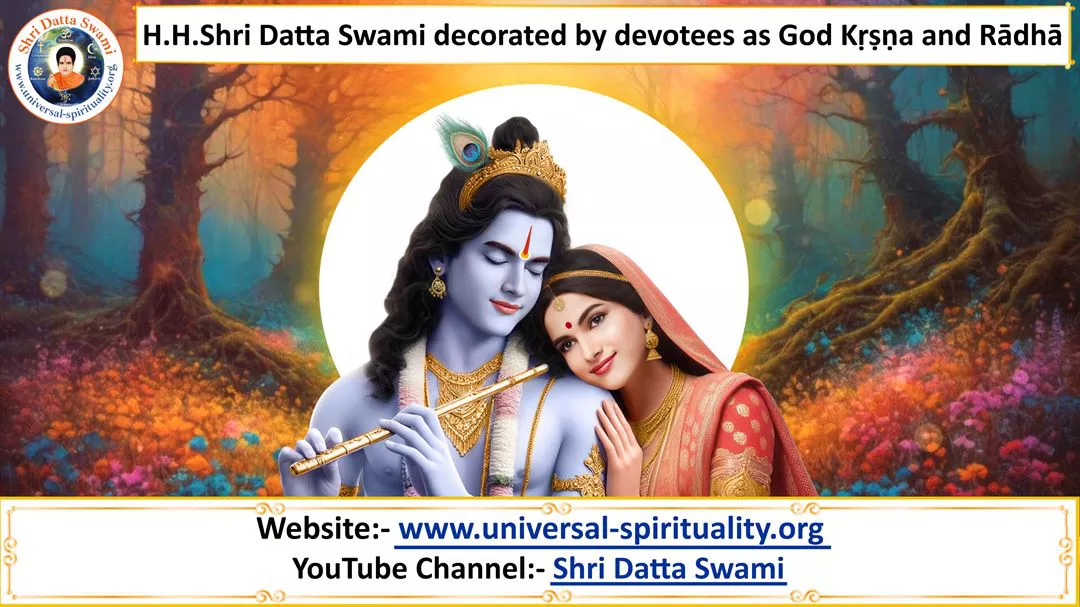
4. When Krishna & Radha are seen separately, what do You mean by “We cannot distinguish between Parabrahman and His power”?
[Swami, I am not at all treating Parabrahman and Mahaa Maayaa differently in the unimaginable domain. My doubt is only for the imaginable domain. What I understood from this is that in the manifested state, since we are able to see Krishna and Radha separately, that is what is meant by "We can distinguish between Parabrahman (God) and Mahaa Maayaa (God’s power).” Is that concept correct?]
Swami replied:-
5. Swami, the non-difference is confined to the unimaginable domain and the difference is confined to the imaginable domain. Isn’t it?
Swami replied:- In the imaginable domain, suppose when you see two golden balls that are exactly equal to each other in quality, quantity and form, you can say that both are not different from each other. Therefore, we can find non-difference in the imaginable domain also. But here, we can distinguish the two golden balls separately. In the unimaginable domain, we cannot separate two unimaginable items like this and hence, we cannot even say that there are two unimaginable items, whereas in imaginable domain, we can say that there are two golden balls separately. Hence, the non-difference is complete in the unimaginable domain, whereas the non-difference is partial in the imaginable domain. You should not argue that in the unimaginable domain, when we can’t say that two are existing, we also cannot say that even one is existing. We oppose your logic because at least one unimaginable item must exist, which is inferred through unimaginable events called miracles.
6. Can we say that God is absent in Kala and Amsha avatāras?
[Swami, Kala and Amsha avatāras are the incarnations of God’s power, where God Himself does not enter directly. In that case, can we truly say that God’s presence is absent in these avatāras? If the only difference lies in the magnitude of the divine power expressed and in both cases God Himself is not directly present, then on what basis are they still called incarnations of God?]
Swami replied:- Since God is omniscient and omnipotent, we can assume His effective presence everywhere even though He is not literally present anywhere. Only in the Āveśa (temporarily existing), pūrṇa (complete) and Paripūrṇa (most complete) incarnations, He literally exists. In the other two types of incarnations called Kalā (a radiation) and Aṃśa (a part of His total power), His power alone exists. In these two incarnations also, God exists effectively though not literally. You may argue that since God effectively exists everywhere in the world, we may call the world as one of these two incarnations (Kalā and Aṃśa). We can call the world as the incarnation of Kalā type with the name Viśvarūpa as said by the Veda (Pādo'sya viśvā bhūtāni). The meaning of this Vedic statement is that the world is a radiation of the power of God. In the unimaginable domain, we cannot say that two unimaginable items called unimaginable God and unimaginable power exist. From this point of view also, we can call these two types of incarnations of power of God as the incarnations of God. You shall not argue that if the world is the incarnation of God, why should the soul get liberation from the world? The answer is that the soul is getting liberation from the fascinations of worldly bonds and not from creation or the world. The union with God happens for the soul in the creation itself in some upper energy world like Brahma Loka or abode of God. The soul with a tiny energetic body merges with the huge energetic body of mediated God present in Brahma Loka, which is within the creation itself.
7. If God’s power only entered Radha, how can She be considered God?
[Swami, Radha is described as an incarnation of God’s power and yet She is accepted as God Himself. In her case, the magnitude of divine power is even higher—perhaps the highest—compared to Kala and Amsha avatāras. However, it is still God’s power (and not God Himself) only that has entered in her case too. Then, how can She be considered as God? I have no doubt about Her divine status, but logically it becomes difficult to reconcile this with the earlier concept that Kala and Amsha avatāras are only embodiments of power and not God Himself. Kindly explain how to correlate these two seemingly contradictory concepts.]
Swami replied:- Rādhā is the most complete incarnation (Paripūrṇa Avatāra) of the unimaginable God or the unimaginable power of God. In the unimaginable domain, we cannot distinguish unimaginable God from unimaginable power. Only one item exists, which may be called as unimaginable God or unimaginable power. It is complete and perfect non-difference between God and Power in the unimaginable domain. Since you are a scholar in physics, you want to understand every item and the power of every item. But, all your understanding is only in this imaginable domain and hence, you can understand all items and all the powers. But, this is the study of both unimaginable domain (Parabrahman and Mahā Māyā) and also imaginable domain (multiplicity of items). Therefore, in certain items and in certain powers, you have to admit your incapability of understanding and such items and powers should be named as unimaginable items, which mean that they cannot be understood not only by you but also by anybody. You are always trying to understand the unimaginable domain and this is leading to the generation of so many questions. Unimaginable items are always beyond space and time and hence, they are beyond the imagination of anybody. You want to understand them with My help. I cannot make them imaginable to any human brain. I can only tell the reason why these unimaginable items are beyond the human imagination. You are a salt doll and pray Me to show the depth of the ocean. I catch you in My hand and swim in the ocean to show the middle depth of the ocean. Every time, the tragedy that happens is that you dissolve in the ocean and I reach the middle of the ocean with both vacant hands only. What I can do is that on the seashore itself, I will teach you that you dissolve in the ocean and therefore, you cannot experience the depth of the middle ocean, which is called as the unimaginable domain!
8. Shouldn’t Radha be considered an Amsha avatāra from the point of power?
[Radha is said to be the incarnation of God’s power called Hlādinī Śakti, which is a specific type of divine power and not the total power of God. Is this understanding correct? If so, then from the standpoint of power, shouldn’t she be considered as an Amsha avatāra (partial incarnation)? In raising this question, I am not considering the viewpoint that she is an incarnation of Lord Shiva and hence God from that angle. Rather, I seek clarification purely from the perspective of divine power entry into Her.]
Swami replied:- When you take an electron for study, don’t you think that both quantum mechanics and wave mechanics are simultaneously existing side by side since the electron is exhibiting the nature of particle and the nature of wave simultaneously? You may be studying one mechanics only for one day and you may be studying the other mechanics the next day. Does it mean that both branches of study exist alternatively each in one day? Your study is not the real existence of the electron because the dual nature of the electron as particle and wave is constantly simultaneous. Hence, when you take Rādhā for study, one day She is not Hlādinī power and the other day She is Lord Shiva. Dualism exists only in the imaginable domain. In the unimaginable domain, only monism exists.
9a. How does an Amsha avatāra “derive” power from God?
[Swami, You said that sage Vyasa was an Amsha avatāra. You mentioned, “He has derived power from God. He is not God. Once the power is derived, there is always a chance that it may be misused.” Based on this, I have the following questions:
How exactly does an Amsha avatāra “derive” power from God? Is it not that the power is directly granted by God Himself? If so, what is the precise meaning of “deriving” power?]
Swami replied:- The power given by God is unimaginable since it performs unimaginable events called miracles. The unimaginable power is derived by the devotee through an unimaginable way or process. If it is imaginable power, I will ask you this question because you can better explain Me as a scholar in Physics. What I can say is that the precise meaning of the derivation of power as well as the power are beyond space and time and are unimaginable.
b. Is an Amsha avatāra receiving power from God likely to misuse it?
[Does this statement imply that an Amsha avatāra, having received power from God, still has a possibility (even if rare) of misusing it? If that is the case, then how is such an avatāra different from a demon who is also granted powers by God? Kindly clarify this difference and enlighten me.]
Swami replied:- In the case of demons, they will certainly misuse the derived powers from God. In their case, the power is not given to a demon. Whenever the demon wants to perform a miracle, God Himself performs that miracle spontaneously so that the demon thinks that he has done that miracle using the power of God derived by him. In the case of human beings, the power is granted, but the same power is under the control of God so that whenever the human being misuses, God withdraws the power. Only to angels, God grants some powers and is detached from the angels since they will not misuse the power under any circumstances. God also never misuse the power like angels. God is the owner of the power, whereas angel is a temporary owner of the power made by God. There is no difference between God and the incarnation of God.
10. When God didn’t enter in an Amsha avatāra, but only granted power, then how does “blame goes to God” apply in such a case?
[Swami, in continuation of the previous statement, You said: “God can take back that power. When God has entered into those forms, then the blame will go to Him.” What is the exact meaning of this statement with respect to an Amsha avatāra? If God has not directly entered in an Amsha avatāra, but has only granted power, then: How does the concept of “blame going to God” apply in such a case? Does this statement refer only to full incarnations where God directly enters, or does it have any relevance to Amsha avatāras as well? Kindly clarify this subtle distinction.]
Swami replied:- When the power is misused by any human incarnation, the power is withdrawn by God since human beings may err. Paraśurāma erred and was insulted by another human incarnation called Rāma. There is a chance of error in a human being, which means that the error may happen or may not happen. Paraśurāma is Āveśa Avatāra (temporarily existing incarnation). Āveśa is greater than Aṃśa. When I explained Āveśa, Aṃśa is naturally understood. The point here is that the shortcomings belong to the media of the incarnations and not with the God-component or Power-component present in it. Since the God-component and the human being-component are perfectly merged, the mistakes made by the human being-component lead to the blame of God. God enters only into angels and human beings. There is no possibility of error in angels, but there is a possibility of error in human beings. In fact, Paraśurāma acted as if He had erred only to show this concept and actually, Paraśurāma did not err. The God-component takes care by controlling the closest human being-component so that God is not blamed. The above concept is just to tell that the human being-component may err and never the God-component.
11. What is the difference between Amśa and Āveśa avatāras?
[It is said that the personality of God enters Āveśa avatāra, Pūrṇāvatāra and Paripūrṇāvatāra, but not Kalā and Amśa avatāras. Hence, these three are directly associated with God. In the case of Parashurama, an Āveśa avatāra, God departed after the divine mission was completed. Considering the cases of Parashurama and Vyasa, can we conclude that: a) An Amśa avatāra does not misuse the divine power throughout life, b) Whereas an Āveśa avatāra may not be able to retain or sustain that divine power continuously? Is this understanding correct, or is there a deeper distinction between these two types of avatāras? Kindly clarify.]
Swami replied:- Sage Vyāsa was always composing scripture after scripture, which is the theoretical phase. Similarly, Paraśurāma was continuously cutting the heads of kings to make the earth clean and peaceful with justice upheld, which is the practical phase. For the practical phase, God is directly needed. For the theoretical phase, the will of God is sufficient to do the work. All the ten famous incarnations were involved in practical reformations of humanity on this earth. Once Rāvaṇa was killed, God Rāma was invited back to His abode. Similarly, when the work was over, God left Paraśurāma. This is the case with any incarnation. Ādi Śaṅkara and Swami Vivekananda also left their bodies once the work was over. In the case of Paraśurāma, the work was over in a short time. Paraśurāma did not leave His gross body like Ādi Śaṅkara because His help was needed by some devotees in the future. Paraśurāma acted as if He was infected by ego and hence, God left Him. He only acted as if He was affected by ego. He did so to preach the humanity that even incarnation will fail if it is affected by the ego.
12. Can Pandavas be categorized as either Kalā avatāra or Amśa avatāra?
[It is said that the Pancha Pandavas are incarnations of God’s power and not God Himself. In that case, can they not be categorized as either Kalā avatāra or Amśa avatāra? If they are not considered as any type of avatāra, what is the logical basis for this distinction? While it is understandable that one may elevate a personality of a lower spiritual status to a higher spiritual status. But we can’t bring down the status of someone who is truly at higher spiritual status to a lower one. Please provide the logic of denying them (if at all) or avoid classifying them as atleast Kalā or Amśa avatāra despite they are incarnation of power of God.]
Swami replied:- Certainly, Pāṇḍavas are Aṃśāvatāras of God Shiva and Draupadī is Aṃśāvatāra of Goddess Mahā Kālī, who descended to earth to destroy the evil forces and establish justice. The five heads of God Shiva have become these five incarnations. God Krishna was the fullest incarnation of God Vishnu. God Vishnu and God Shiva are always united to destroy injustice. Rāma was the incarnation of God Vishnu and Hanumān was the incarnation of God Shiva.
13. If Kalā avatāra is an incarnation of God’s power but not of God, does it imply that God and His power are different?
[Vedavyasa or Kalā avatāras are described as incarnations of a part of God’s power and not of God Himself. Does this imply that God and His power are different? If so, can we conclude that power and the possessor of power are distinct, at least within the imaginable domain? Is this understanding correct? Kindly clarify.]
Swami replied:- In the imaginable domain, the power and possessor of power are qualitatively similar, but quantitatively different. Any difference will isolate one substance from the other substance even if there are 100 similarities.
14. In which context does the following statement become complete?
[Swami, You mentioned: “God and the power of God are one and the same—this statement is limited to a certain context and should not be taken in complete sense.” In which context is this statement valid and in which context does it become complete? Kindly explain the precise contexts where God and His power are considered same, and where they are to be understood as distinct.]
Swami replied:- As told above, in the unimaginable domain, Parabrahman and Mahā Māyā are one and the same because two unimaginable items can’t be distinguished since their boundaries are invisible. In imaginable domain, the possessor of power and power differ quantitatively even though they are one and the same qualitatively.
15. How can the two following viewpoints be reconciled?
[Goddess Parvati, Goddess Lakshmi and Goddess Sarasvati are all described as incarnations of God’s power. Yet, You said that they are God Himself. In this case, it appears that the statement “God and the power of God are one and the same” is fully applicable. However, this seems to contradict the earlier logic where God and His power are treated as distinct in certain contexts. How can these two viewpoints be reconciled? Kindly clarify this apparent difference in logic. Please remove all these ignorances as You only can remove all my darkness. At Your divine lotus feet, Chhanda always.]
Swami replied:- The power and the possessor of power cannot be distinguished in their bottommost layer called the unimaginable domain. This is the state of absolute reality. As you go to the upper layers, a distinction appears, which is in quantitative sense. Qualitatively, both are one and the same. The sunlight that spreads all over the world is very dilute. But, the substratum (sun) that emits the light, is very very concentrated form of matter and if this matter converts into energy, the entire creation will be burnt. Śakti or Power is famous for its speed and the Possessor of Power or Substratum, in the form of matter that is equivalent to unimaginable amount of power, remains peaceful. The Power always has the support of the Possessor of Power and hence, the Power can be treated as God like the Possessor of Power. The background Possessor of Power will interfere whenever there is a need for the Power. Hence, the Power is indirectly God only. The Possessor of Power and the Power are inseparable like word and its meaning.
★ ★ ★ ★ ★
Also Read
Swami Answers Questions Of Smt. Chhanda
Posted on: 23/03/2026Swami Answers Questions Of Smt. Chhanda
Posted on: 07/10/2023Swami Answers Questions Of Smt. Chhanda
Posted on: 25/09/2024Swami Answers Questions Of Smt. Chhanda
Posted on: 10/02/2025Swami Answers Questions By Smt. Chhanda
Posted on: 26/04/2023
Related Articles
Difference Between Unimaginable Power And Imaginable Power Disappears In Ultimate Stage
Posted on: 02/09/2017God Sanctioned Process Of Creating Imaginary World
Posted on: 04/09/2015Shri Dattaguru Bhagavat Gita: Kaalabhairava Khanda: Chapter-14 Part-2
Posted on: 26/08/2018Does Yoga Maaya Cover God Due To Which God Becomes Invisible And Unimaginable To Souls?
Posted on: 14/12/2021